
Provably Fair: How We Verify Game Results
Our Duel gambling provably fair system is designed to make completed results on eligible Duel house games independently checkable.
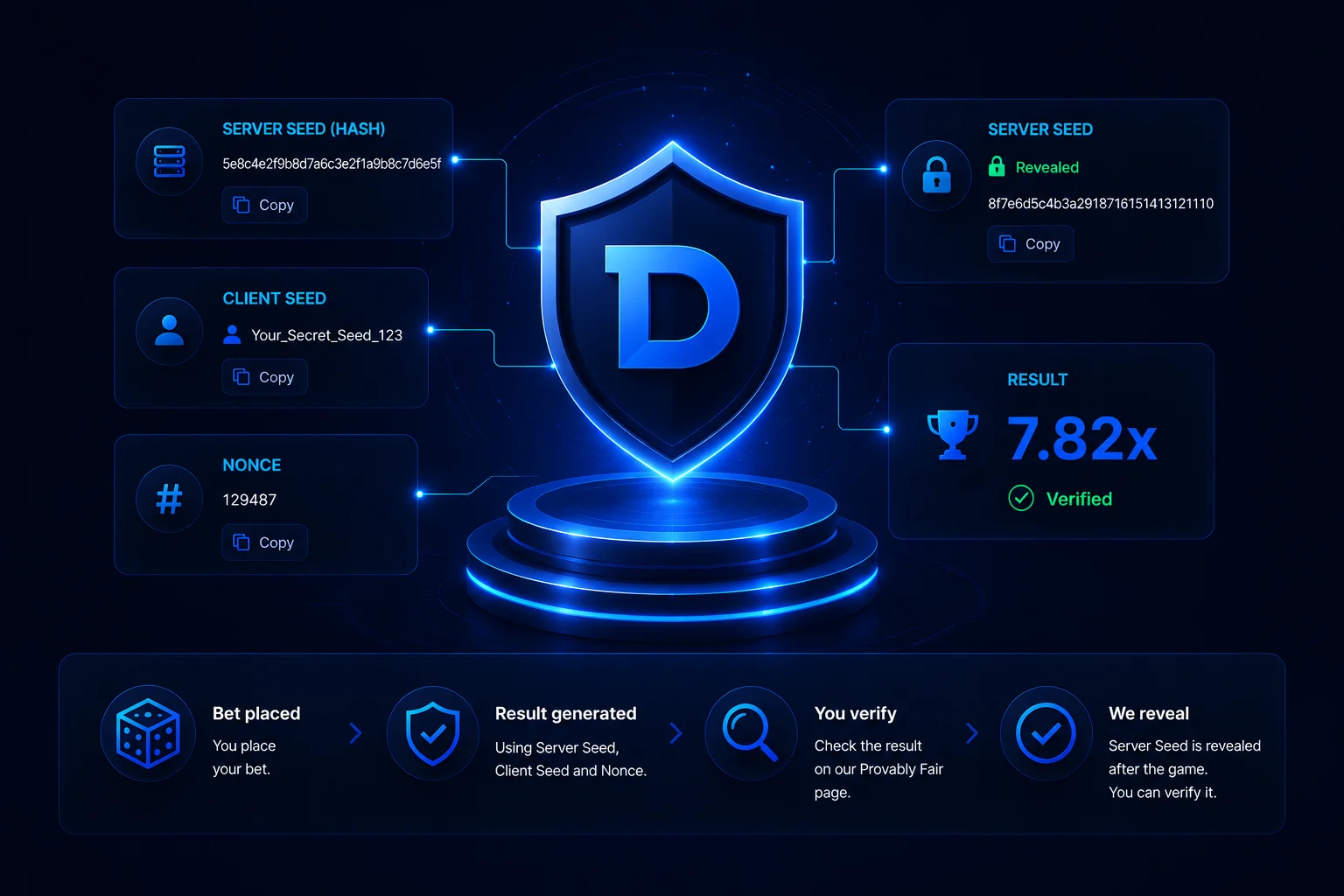
Instead of treating a finished round as a black box, we provide the data needed to verify how the outcome was produced. This page explains the core process, the game-specific differences, which Duel games currently have fairness documentation, and how to verify a result after play.
What Provably Fair Means on Duel
On Duel, Provably Fair applies to our house games and gives you a way to check completed outcomes using the cryptographic data behind them. Our Provably Fair system applies to eligible Duel house games and allows completed results to be independently checked using the verification information we provide. The Duel casino provably fair system is therefore about verifiability: you can check the committed server-seed information and confirm that the relevant inputs reproduce the result you received.
That does not mean a round will be profitable or that the next result can be predicted. Provably Fair verifies how a completed outcome was generated; it does not remove randomness or guarantee a win. For our broader mix of Originals, slots and live games, see Duel Casino Games.
How Our Provably Fair System Works
The Duel provably fair process starts with a server seed generated by us and another source of randomness used alongside it. In many house games, the client seed can be chosen by you or generated automatically, while a nonce identifies the round and increases as you play. Some games also use a cursor to generate multiple values within the same round. Depending on the game, these inputs may be processed using HMAC or another documented game-specific method.
The exact setup is not identical across every game. Crash and Castle Roulette, for example, use public Drand randomness instead of the standard player client seed, and their nonce is fixed at 0. This is why verification should always follow the method documented for the specific game.
| Component | Role in Verification |
| Server seed | Seed generated by Duel and later revealed so its earlier commitment can be checked. |
| Client seed | Player-selected or automatically generated input used by many house games. |
| Nonce | Round identifier used by many Originals; it normally increases between rounds, although some games use a different setup. |
| Cursor | Game-specific counter used when one round requires multiple generated values, such as cards, tiles or Plinko bounces. |
| Drand input | Public randomness used by documented games such as Crash and Castle Roulette instead of the standard client-seed setup. |
| HMAC / game logic | Combines the relevant inputs and converts them into the result required by that particular game. |
How to Verify a Game Result
Start with a completed Duel house-game round and the fairness information available for that game. Our house-game interfaces can show information such as All Bets, Live Bets and Bet ID, while our fairness tools provide the data required to reproduce an outcome. Once the relevant server seed has been revealed, the round can be checked through our fairness/verify page.
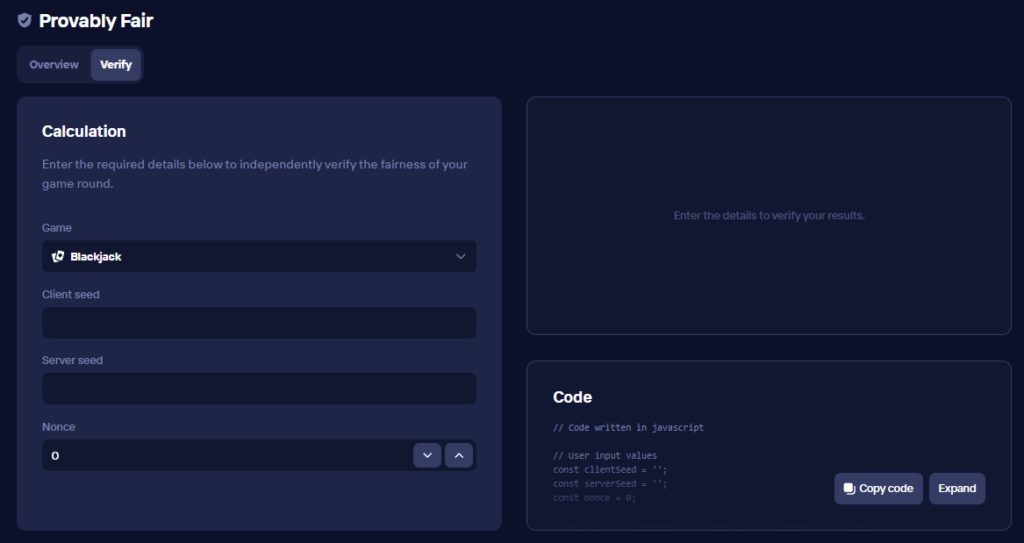
First, identify the completed bet you want to review. Then collect the values required by that specific game, such as the revealed server seed, client seed, nonce and, where applicable, a cursor or Drand value. Check that the revealed server seed corresponds to the commitment provided before play. Finally, use the Duel verifier or follow the calculation documented for that game to reproduce the recorded outcome. A successful verification shows that the disclosed inputs and documented calculation are consistent with the completed result.
Which Duel Games Are Provably Fair?
Our current Provably Fair Scrolls contain individual documentation for nine house games: Plinko, Blackjack, Mines, Dice, Crash, Keno, Castle Roulette, Beef and Video Poker.

The level of supporting documentation is not identical for every title, so we separate games with dedicated technical guides from those confirmed elsewhere on Duel. We also do not extend our house-game verification system automatically to third-party slots, live casino games or game shows. For the wider selection, see Duel Casino Games.
| Game / Category | Provably Fair | Verification Available |
| Dice | Yes | Yes – dedicated Duel PF documentation |
| Blackjack – Duel Original | Yes | Yes – dedicated Duel PF documentation |
| Plinko | Yes | Yes – dedicated Duel PF documentation |
| Crash | Yes | Yes – dedicated Duel PF documentation |
| Mines | Yes | Yes – dedicated Duel PF documentation |
| Beef | Yes | Yes – dedicated Duel PF documentation |
| Keno | Yes | Yes – dedicated Duel PF documentation |
| Castle Roulette | Yes | Yes – dedicated Duel PF documentation |
| Video Poker | Yes | Yes – dedicated Duel PF documentation |
| Groomer’s Van | Yes – labelled Provably Fair on Duel | Check the current game fairness information |
| Live Blackjack | Not confirmed under the house-game PF documentation | No house-game verification method confirmed |
| Third-party slots / live casino / game shows | Not automatically covered | Not through our house-game verifier unless explicitly confirmed |
Provably Fair and Duel Blackjack
Our in-house Blackjack has its own Provably Fair documentation. The game uses a client seed, server seed, nonce and cursor, with the cursor increasing for each card dealt. Our Blackjack guide explains how those values are combined through HMAC and converted into card results, allowing a completed hand to be checked against the published method.
This applies specifically to our Original Blackjack. Live Blackjack is presented separately on Duel and does not have a dedicated entry in our current Provably Fair Scrolls collection, so we do not automatically apply the same verification method to it. For more information about both formats, see Duel Blackjack.
What Verification Can and Cannot Prove
Verification can show that the disclosed seed information is consistent with the commitment made before play and that the documented inputs reproduce a completed outcome. Depending on the game, that may mean checking a dice result, a shuffled sequence of cards or tiles, a Plinko path, or a multiplier generated with Drand-backed randomness. It gives you a practical way to audit a finished round rather than relying only on the result shown on screen.
It cannot predict the next round, prevent losses or guarantee a winning session. Provably Fair is also different from RTP or house edge. Fairness verification checks how a specific result was generated; RTP and house edge describe the mathematical return or advantage associated with a game’s design. A result can therefore be fully verifiable and still be a losing one. Our own Blackjack documentation makes the same distinction between random results, RTP and guaranteed outcomes.
Provably Fair vs Third-Party Casino Games
Our Provably Fair framework is built around Duel house games, where we publish the information needed to audit the result-generation process. That is why our game-specific documentation can explain inputs such as server seeds, client seeds, nonces, cursors, Drand values and the calculations used to turn them into a result.
Third-party slots, live casino games and game shows sit outside that documented house-game framework. Duel lists provider content separately from our Originals, including slots from external studios and live casino titles supplied through dedicated live-game categories. Our current Provably Fair documentation does not state that the Duel house-game seed verifier applies to those games.
Being available on Duel therefore does not, by itself, mean that a game uses our house-game verification method. We only describe provider content as supporting a particular Provably Fair process when that is explicitly confirmed for the specific game.
Frequently Asked Questions
Is Duel Provably Fair?
Our house games are Provably Fair, and we provide verification information plus game-specific documentation for supported Originals. That does not mean every third-party game available on Duel uses the same system.
Which Duel Games Are Provably Fair?
Our current Provably Fair Scrolls cover Plinko, Blackjack, Mines, Dice, Crash, Keno, Castle Roulette, Beef and Video Poker. Other games should only be included when their Provably Fair status is separately confirmed by Duel.
How Do I Verify a Result on Duel?
Use the completed bet and its relevant fairness data, then check the result through our fairness/verify tool or follow the game-specific calculation provided in our documentation.
How Does Duel’s Provably Fair System Work?
Many Originals combine a server seed with a client seed and round data such as a nonce or cursor, while games such as Crash and Castle Roulette use Drand-based randomness. The exact method depends on the game.
Is Duel Blackjack Provably Fair?
Yes. Our in-house Blackjack has dedicated documentation explaining how its seed, nonce and cursor data are used to generate and verify card results.
Are Live Casino Games Provably Fair?
We do not automatically apply our house-game Provably Fair system to live casino content. A live title should only be described as supporting a particular verification system when that is explicitly confirmed for that game.